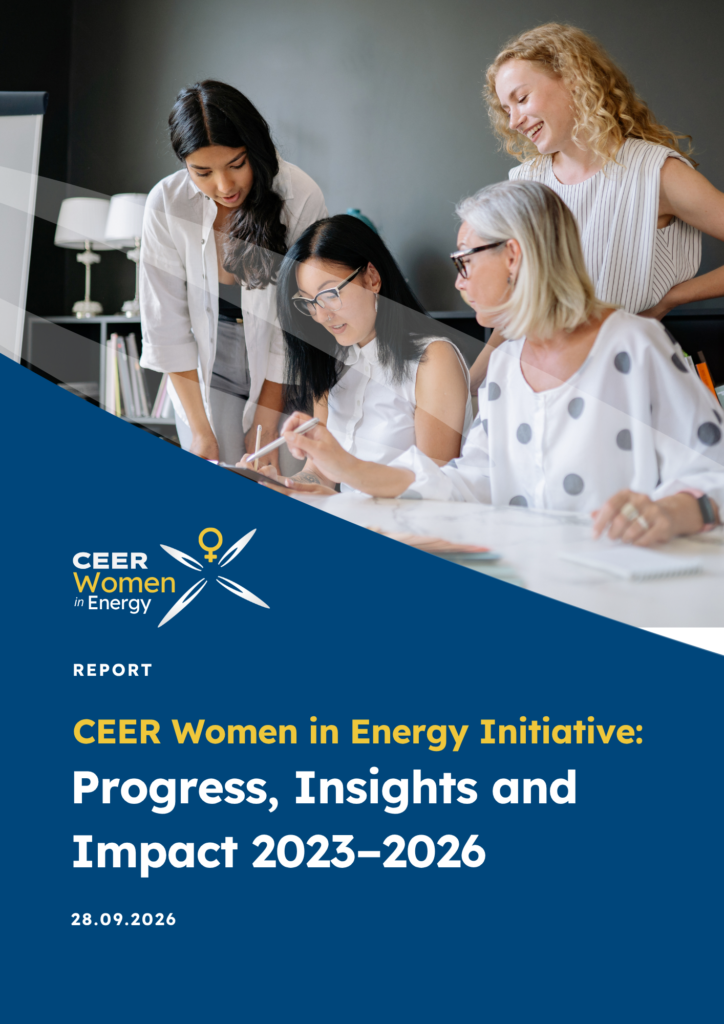
CEER Women in Energy Initiative: Progress, Insights and Impact 2023-2026
Context
Women account for around 20% of the global energy workforce, despite making up about 40% of the global workforce and hold fewer than 20% of senior leadership positions. They are also underrepresented in STEM roles, just as demand for these skills grows with the energy transition. Gender stereotypes, a sector long perceived as male-dominated and persistent workplace barriers all play a part.
CEER launched its Women in Energy Initiative in 2023 to promote gender equality within its members and observers and across the wider energy sector. This report looks at what has been achieved since, from the annual Awayday and the Women in Energy Newsletter to the Gender Equality Charter launch, now signed by 10 organisations. It also covers the Women in Energy Committee, which brings together 26 colleagues, as well as the EU4Energy Women in Energy Blog. Gender equality is now a strategic priority in the CEER Strategy 2026-2029 for the first time.
Key Findings
The report draws on CEER's annual gender equality surveys of National Regulatory Authorities (NRAs), including a 2026 survey of Eastern Partnership regulators under EU4Energy.
- Women make up 52.5% of the workforce in NRAs on average, but only 34.3% of senior management and 29.8% of executive or board positions.
- Just under half of NRAs (47.1%) have a dedicated gender policy, while 76.5% draw on external equality frameworks.
- Flexible working is the most common action (16 of 18 NRAs). Mentoring, leadership development and career development schemes are each reported by only 10.
- 56% of NRAs have no monitoring processes for gender equality in place.
The challenge is therefore not attracting women into the sector per se, but ensuring they progress into leadership.
Future Focus Areas
The Initiative's work is structured around six key focus areas, spanning leadership representation, STEM careers, governance, monitoring and inclusive workplace practices. Its next phase rests on five priorities: mainstreaming Women in Energy across CEER's structures, measuring progress through consistent monitoring, investing in capacity building, strengthening external partnerships and growing the Women in Energy community.
The aim is to embed gender equality as a sustained, measurable part of CEER's work, so that the momentum of the past three years translates into lasting change.